
Dropshipping for Shopify in India: A Practical Guide With Real Margin Math
5 November 2026 · 12 min read · by Courier Uncle team

Dropshipping for Shopify in India: A Practical Guide With Real Margin Math
The pitch for dropshipping for Shopify sounds simple: no stock, no warehouse, just sell. In India, the real story is a bit different. COD orders, RTO and slow supplier dispatch decide whether you earn anything at all.
This guide does not promise quick money. It shows how dropshipping works, what the math looks like once COD and RTO are included, how to check a supplier before you trust them, and when dropshipping stops making sense.
It is written for new D2C founders, shopkeepers moving online, and Meesho or Amazon sellers who want to try a Shopify store, whether you are in Mumbai, Bangalore, Delhi NCR, Noida, Chennai or a smaller town.
What Is Dropshipping on Shopify?
Dropshipping on Shopify means you sell products on your own store, but you do not keep the stock. When a customer orders, your supplier packs the product and ships it straight to the customer.
Three people are involved: you (the seller), your supplier, and the customer. The courier works on the supplier’s side.
One thing is easy to miss. You do not own the product, but the customer sees your brand. So if the parcel is late or damaged, the customer blames you, not the supplier.
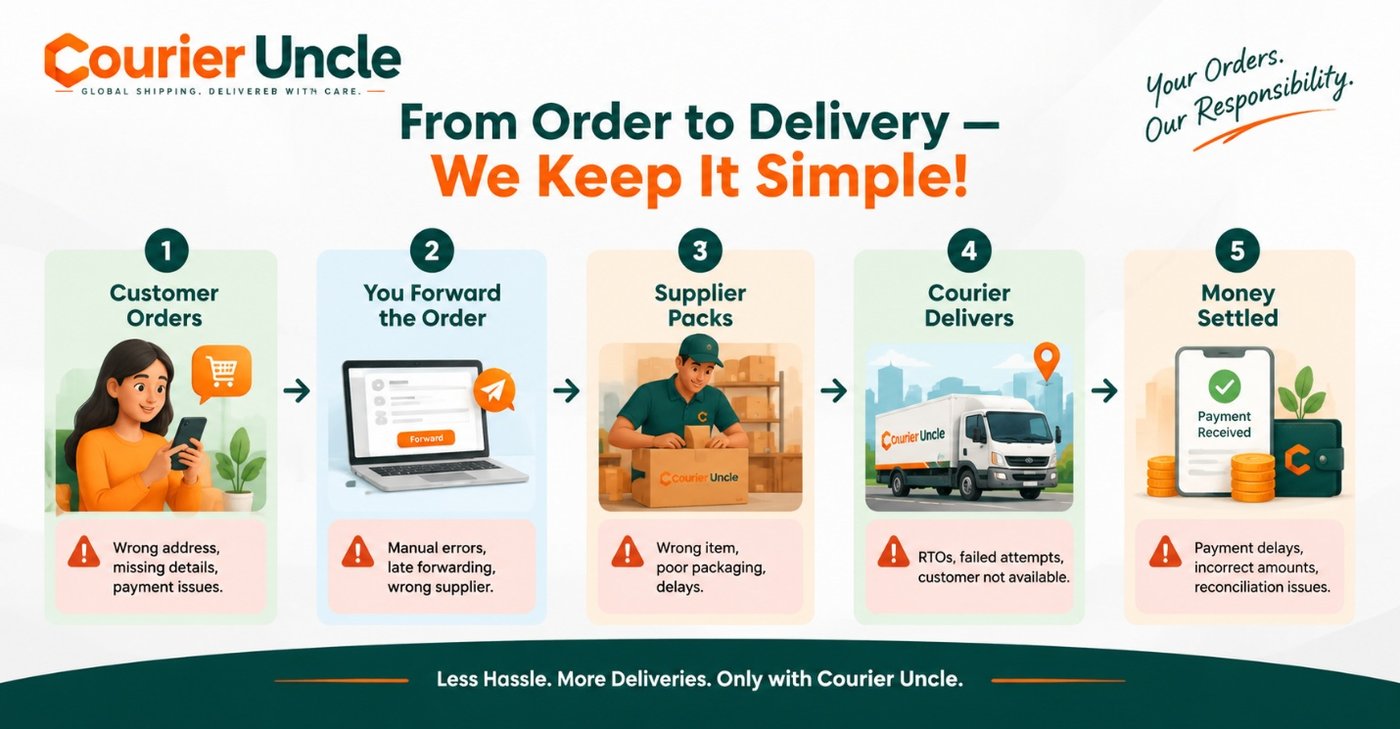
A customer places an order on your Shopify store, as COD or prepaid. What can go wrong: a fake or careless COD order.
You send the order details to your supplier, by hand or through a connected tool. What can go wrong: a delay in forwarding, or a wrong address.
The supplier packs and dispatches the parcel. What can go wrong: slow dispatch, or poor packaging.
The tracking number reaches you and then the customer. What can go wrong: tracking comes late, so the customer worries.
The courier delivers the parcel. What can go wrong: a failed delivery attempt or a refused COD parcel.
The money is settled. What can go wrong: slow COD settlement, or a return where the supplier keeps your payment.
Shopify lets you connect suppliers through different apps and marketplaces. Their features and prices change often, so check the current options yourself before you choose.
The Real Margin Math (Most Guides Skip This)
Most guides stop at “selling price minus product cost.” That leaves out the costs that actually decide your profit in India. Use this instead:
True profit per order = selling price − product cost − shipping − COD fee − RTO loss − ad cost per order
Here is an example with made-up numbers, only to show how the math works. Say you sell a product for 999. Your ₹ supplier charges 450. Shipping is 80 each way, the COD fee is 30, and you spend 250 on ads for every order ₹ ₹ ₹ ₹ placed.
| Per 100 COD orders placed | Example A: no RTO | Example B: 25% RTO |
|---|---|---|
| Orders delivered | 100 | 75 |
| Sales ( 999 x delivered orders)₹ | ₹99,900 | ₹74,925 |
| Product cost paid to supplier ( 450 x delivered ₹ orders) | ₹45,000 | ₹33,750 |
| Forward shipping ( 80 x all 100 orders)₹ | ₹8,000 | ₹8,000 |
| Return shipping ( 80 x returned orders)₹ | ₹0 | ₹2,000 |
| COD fee ( 30 x delivered orders)₹ | ₹3,000 | ₹2,250 |
| Ad cost ( 250 x all 100 orders)₹ | ₹25,000 | ₹25,000 |
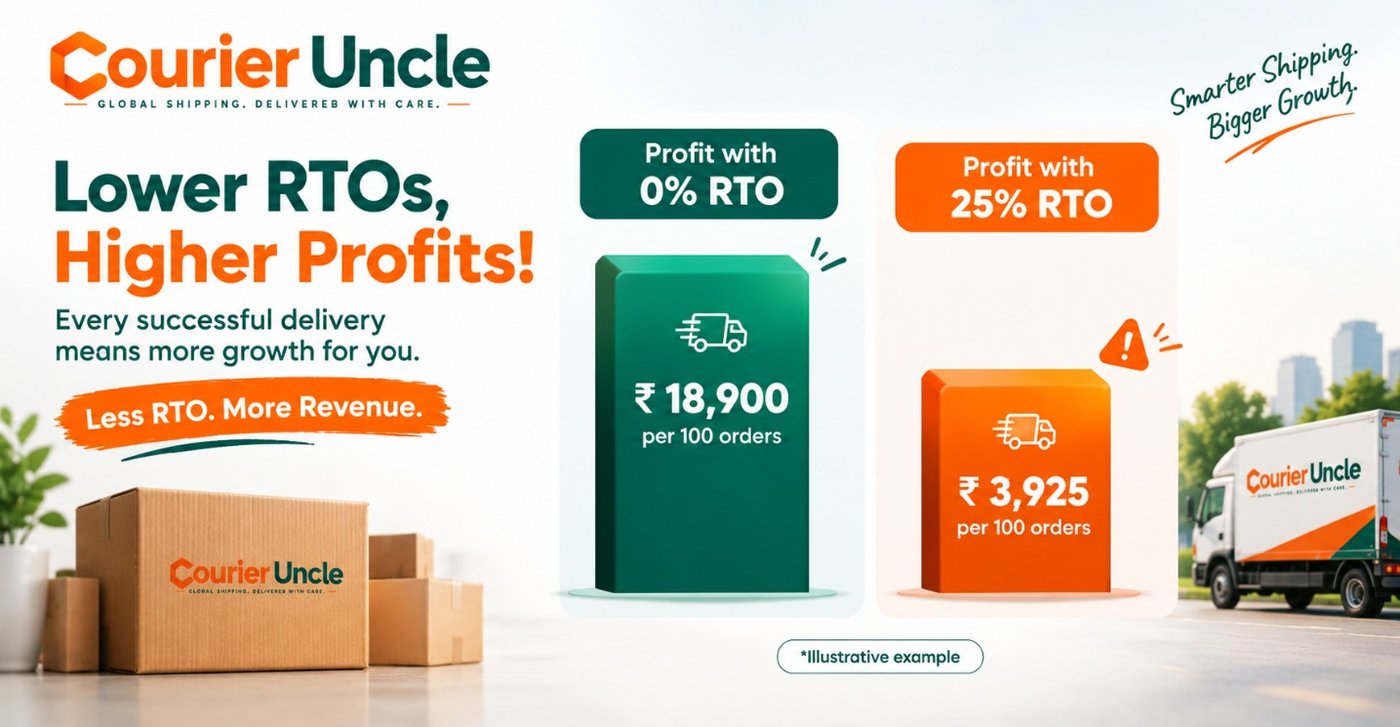
| Profit left | ₹18,900 | ₹3,925 |
These numbers are illustrative. In Example B, the supplier takes the product back on an RTO and does not charge you for it. If your supplier charges for returned or damaged products, your profit is lower still.
Look at what happens. With no RTO, the profit is 18,900 on 100 orders. With 25% RTO, it falls to 3,925. The ad ₹ ₹ money was already spent on all 100 orders, but only 75 produced sales. That is why RTO hurts dropshippers so much.
Now try it with your own numbers:
| Item | Your number | Example |
|---|---|---|
| Selling price | ₹999 | |
| Product cost from supplier | ₹450 | |
| Forward shipping per order | ₹80 | |
| Return shipping per RTO order | ₹80 | |
| COD fee per delivered order | ₹30 | |
| Ad cost per order placed | ₹250 | |
| Your expected RTO % | 25% |
We’ve broken down what RTO really costs a seller here, in case you want to see how much it can eat into a normal month.
Why COD and RTO Hit Dropshippers Harder
COD helps conversion in India, since many first-time buyers are not ready to pay online. But in dropshipping you have less control over what happens after the order.
You do not see the parcel, so you cannot check the packing yourself
The supplier usually picks the courier, so you may not control which courier delivers
When a delivery fails, you may hear about it late, and then it is too late to save the order What you can do:
Confirm COD orders on WhatsApp or by a quick call before you forward them to the supplier
Offer a small discount for paying online
Use partial COD, a small advance, for orders from pincodes with repeat RTO
Limit or stop COD on pincodes that keep returning parcels
We’ve covered the full COD vs prepaid decision here, including how to find the right mix for your store.
How to Choose a Dropshipping Supplier (Checklist)
Your supplier is your warehouse, your packing team and your dispatch desk, all in one. Ask these questions before you trust them with your customers.
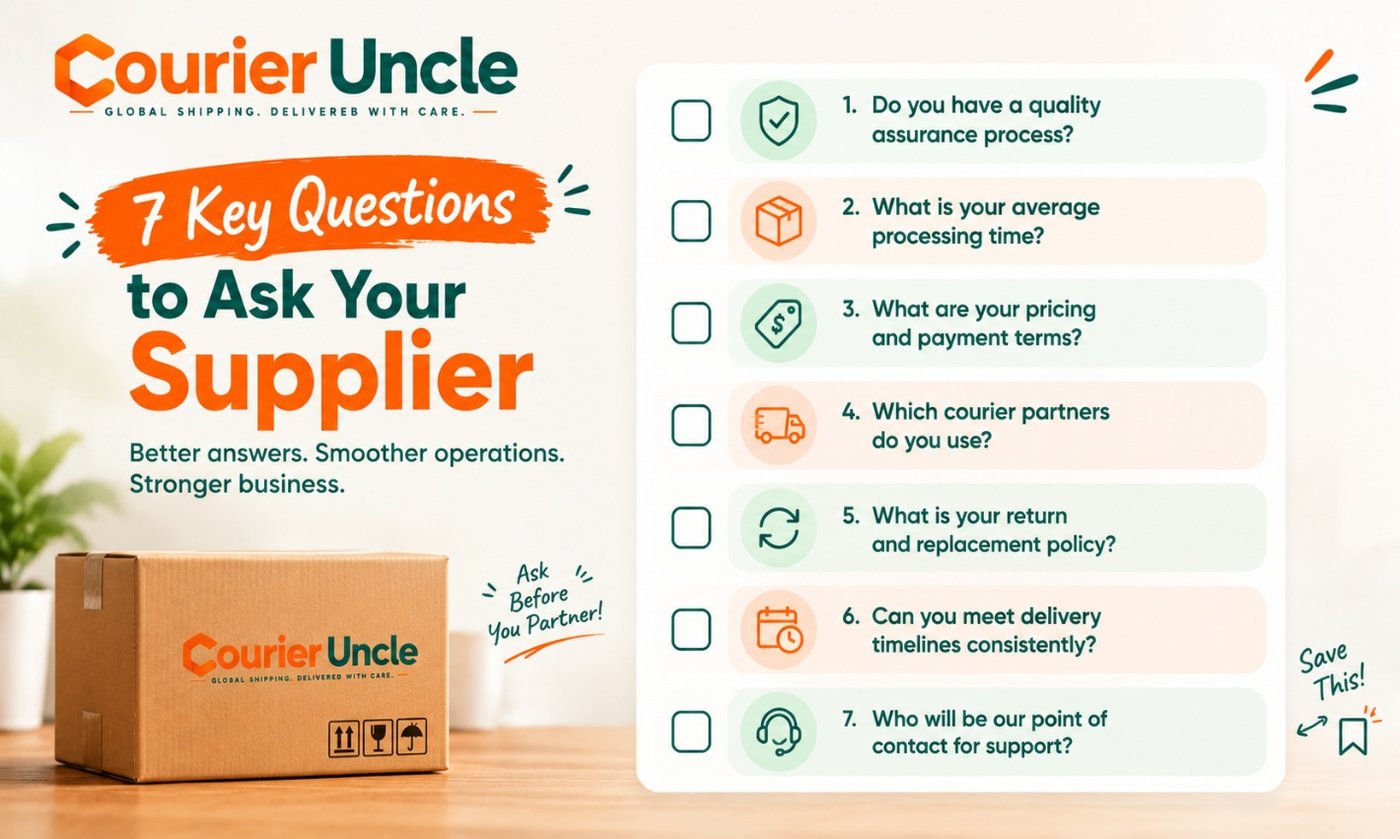
| Ask the supplier | Why it matters | Red flag |
|---|---|---|
| How long to dispatch after I send the order? | Their dispatch time becomes part of your delivery promise | Vague answer, or no written commitment |
| Which courier do you use, and when do I get the tracking number? | You need tracking to calm customers and to act on failed deliveries | Tracking comes days late or not at all |
| Is packaging plain or branded, and who pays for damage? | Damaged parcels become your refunds and bad reviews | No damage policy |
| Do you support COD, and how is COD money settled? | COD is a big share of Indian orders and affects your cash flow | No clear settlement process |
| What happens to returned and RTO parcels? | Decides who bears the product cost on a return | Supplier keeps your money on every return |
| Can I place a test order first? | The only way to see real packaging and speed | Refuses sample orders |
| Where do you ship from? | Distance from your buyers affects delivery time | Location is hidden or keeps changing |
One rule saves a lot of pain: never approve a supplier without placing a test order first. A test order shows you the real packaging, the real dispatch time and how tracking works.
Shopify Store Setup: Only the Shipping-Related Parts
There are plenty of guides on themes, logos and product photos. This section covers only the parts that affect delivery and customer trust.
Shipping policy page: write the delivery time honestly, and include the supplier’s dispatch time in it
Return and refund policy: keep it clear, and make sure it matches what your supplier actually allows
Tracking: make sure every customer gets a tracking link, and add a way to look it up on your store
Checkout: show a realistic delivery estimate instead of the fastest possible one
Support: give a clear WhatsApp number or email, and reply quickly
These small things reduce complaints, disputes and refused parcels more than most people expect.
Dropshipping vs Holding Your Own Stock vs Hybrid
Dropshipping is a good way to test a product idea with very little money. It is not always the best way to run a business over the long term.
| Factor | Dropshipping | Own stock | Hybrid |
|---|---|---|---|
| Starting cost | Lowest | Highest | Medium |
| Control over delivery | Low, the supplier ships | Full, you choose the courier | Full on your own stock, low on the rest |
| Delivery speed | Depends on the supplier | You can plan it | Fast on best-sellers |
| RTO control | Limited | Strong | Strong where you hold stock |
| Margin potential | Thinner | Better | Improves as stock share grows |
Dropshipping makes sense when you are testing products and have very little capital. It stops making sense when RTO or slow delivery starts pushing your customers away.
A hybrid model is a practical middle path. Keep your own stock of the products that already sell well, and keep dropshipping the rest. On the stock you hold, you choose the courier yourself. That is where a courier aggregator becomes useful: Courier Uncle lets you compare multiple courier partners from one dashboard, with same-day pickup, no hidden fees and no minimum commitment.
See how a courier aggregator works for sellers with their own stock here.
If You Already Sell on Meesho or Amazon
A Shopify store can become a separate channel for your own brand and repeat customers, alongside your marketplace sales. Just remember that each marketplace has its own rules for dispatch and delivery, so keep your stock and delivery promises clear when you sell on more than one channel.
Common Dropshipping Mistakes in India
Hiding or guessing the delivery time, and then promising a date the supplier cannot meet
Getting the tracking number late, or not sharing it with the customer
Keeping COD on for every order without any check
Approving a supplier without a test order
Running ads without first checking if the margin works
Using a return policy that does not match your supplier’s policy
A Real Example: A First-Time Shopify Seller in Bangalore
This is an illustrative example, based on a pattern that many new sellers go through.
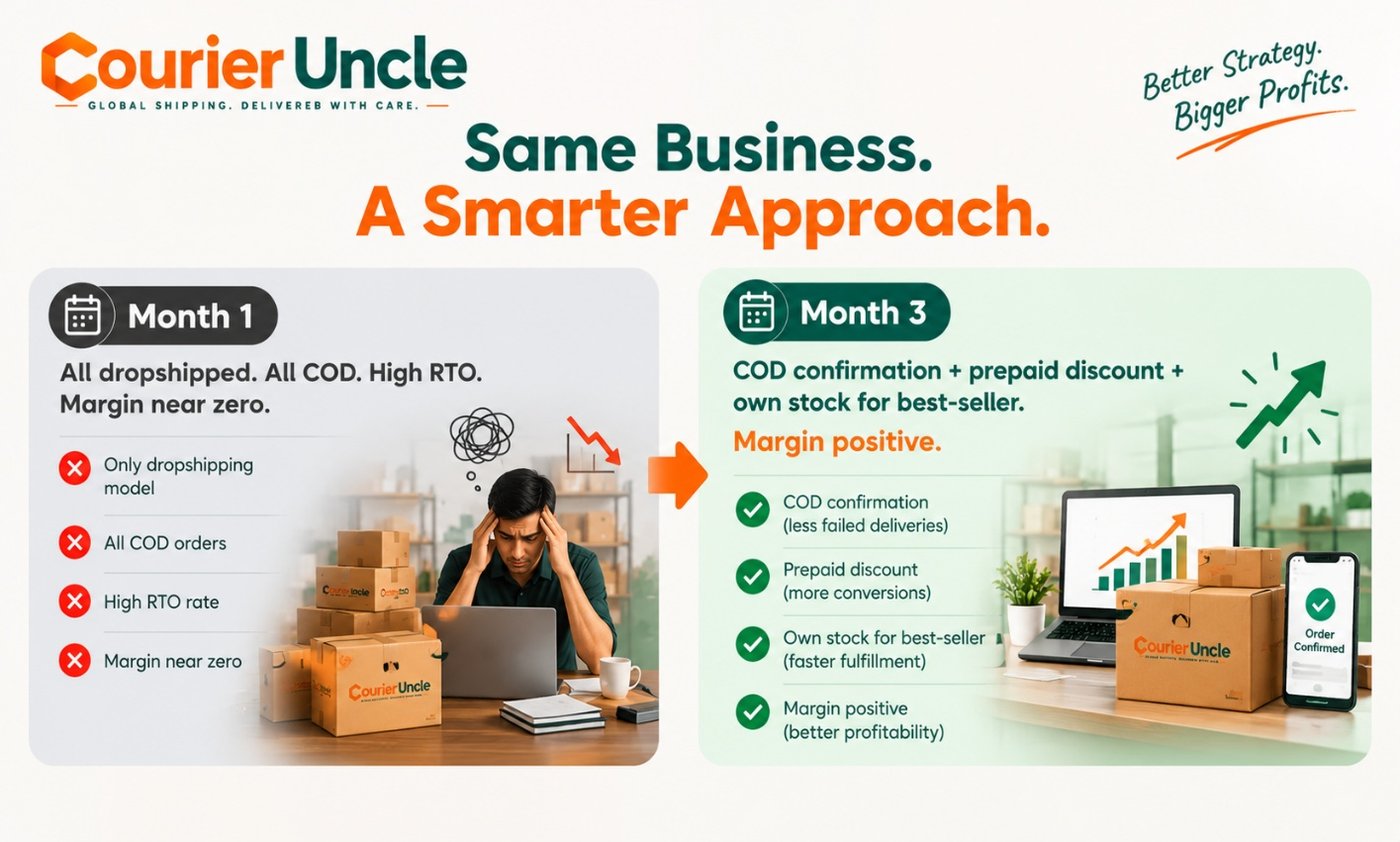
A first-time seller in Bangalore opened a Shopify store selling home décor, with one supplier shipping every order. Most of her orders were COD. In the first month, a large share of the parcels came back as RTO. After ads, shipping and returns, she was earning almost nothing on each delivered order.
She made three changes. She started confirming COD orders on WhatsApp before forwarding them. She added a small discount for paying online. And for her best-selling product, she bought stock and shipped it herself, instead of dropshipping it.
Over the next two months, her RTO came down to a more manageable level, and her margin turned positive again. The change did not come from finding a new product. It came from understanding where her money was leaking.
Frequently Asked Questions
Is dropshipping on Shopify legal in India?
Dropshipping is a normal business model, but you still have to follow the usual rules for running a business in India, such as registration, tax and consumer rules. These rules change, so confirm the details with a CA or a legal advisor before you start.
How much profit can I make from dropshipping?
There is no fixed number. Your profit depends on your selling price, product cost, shipping, COD fee, RTO and ad cost. Use the formula in this guide with your own numbers to see what you would actually keep.
Can I use COD with dropshipping?
Yes, but COD raises RTO risk, and in dropshipping you control less of the delivery. Confirm COD orders before forwarding them, and consider a prepaid discount or a small advance for risky pincodes.
Who pays when a dropshipped order comes back as RTO?
It depends on your supplier’s terms. You usually still pay the shipping, and whether you get the product cost back depends on the supplier’s return policy. Ask this before you start, and not after your first RTO.
How much money do I need to start dropshipping?
It costs less than holding stock, but it is not free. You will usually need money for your store, ads, test orders and any tools you choose. The exact amount depends on your plan, so list your costs before you start.
Do I need GST registration for dropshipping?
It depends on your situation, such as your turnover and what you sell. This is a question for a CA, since the rules can change and depend on your case.
Can I sell on Meesho or Amazon along with my Shopify store?
Yes, many sellers do. Keep your stock, delivery promises and return policies clear across channels, and check each marketplace’s own seller rules.
The Bottom Line
Dropshipping is a cheap way to start, but in India your margin is decided by shipping, COD and RTO, not by the product price. Do the math first, check your supplier with a test order, and only then spend on ads.
Once you find products that sell, keeping their stock yourself gives you control over delivery and RTO, which is usually where the profit is hiding.
Holding your own stock and want to compare courier rates? Check Courier Uncle — free sign-up, no minimum commitment.
Note: All numbers in the margin example and the case study are illustrative, not real results or promises of income. Tools, pricing and rules change, so please verify current details before you decide.
Ship smarter with Courier Uncle
Compare live rates across multiple couriers on your actual routes — sign-up is free, no volume commitment.
Compare rates free →