
GST on Courier Charges: What Is Taxed, at What Rate, and What You Can Claim
9 September 2026 · 5 min read · by Courier Uncle team
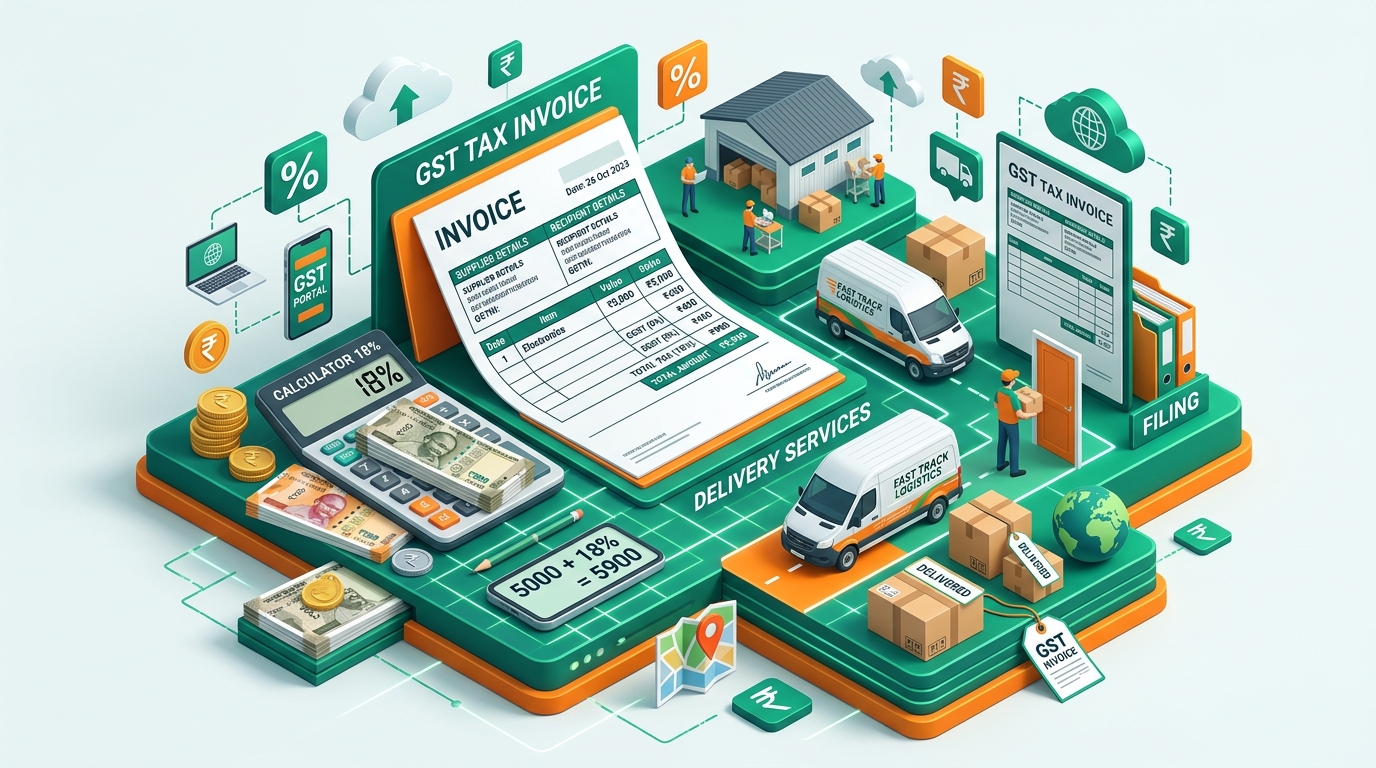
Your courier quote says Rs 100. Your invoice says Rs 118. Nobody cheated you; that is GST, and whether it costs you anything depends entirely on how your business is registered. Here is how tax works on Indian courier charges, what you can claim back, and the two mistakes that quietly cost sellers money.
The rate: 18 percent on courier services
Courier and express parcel services fall under SAC code 9968 (postal and courier services) and attract GST at 18 percent. It applies to the whole service charge: the freight, the COD collection fee, any fuel or handling surcharge and the RTO charge if a parcel returns. It does not apply to the COD amount itself, which is your money being collected and passed back to you.
So a shipment with Rs 90 freight and a Rs 30 COD fee is Rs 120 of taxable service, Rs 21.60 of GST, Rs 141.60 on the invoice.
Whether it costs you anything
This is where the answer splits.
You are GST registered. The Rs 21.60 is input tax credit. You offset it against the GST you collect on your own sales, so your real shipping cost is Rs 120, not Rs 141.60. The courier invoice needs your GSTIN on it and needs to appear in your GSTR-2B for the credit to flow.
You are not registered. The Rs 21.60 is a cost like any other. Your real shipping cost is Rs 141.60. For a seller doing 500 parcels a month at an average Rs 100 freight, that is Rs 9,000 a month of GST with no credit against it, which by itself is a reason to register once you cross the threshold.
Where the credit goes missing
Sellers who are registered still lose input credit in three ways.
The GSTIN is not on the platform. If your GST number is not in your account settings, the invoice is raised to an unregistered recipient and the credit cannot be claimed later. Add it before your first live booking, not after the first invoice.
Wallet recharge is confused with the invoice. Money added to a shipping wallet is a deposit, not a taxable supply. The taxable event is each shipment. The invoice you file against is the shipment invoice (or the periodic consolidated invoice), not the recharge receipt. Sellers who file the recharge receipt find the numbers do not reconcile.
Interstate versus intrastate. Courier services are taxed where the parcel is handed over, which for practical purposes is the pickup location. If your GST registration is in Haryana and the courier’s invoicing entity is in Haryana, you see CGST plus SGST. If the entities are in different states, you see IGST. Either way the total is 18 percent and the credit is the same; the split just needs to match on your return.
GST on the components, line by line
| Line on the invoice | GST applies? | Notes |
|---|---|---|
| Freight | Yes, 18 percent | The base rate for the slab and zone |
| COD collection fee | Yes, 18 percent | The fee, not the amount collected |
| RTO charge | Yes, 18 percent | Charged only if the parcel returns |
| Weight discrepancy charge | Yes, 18 percent | The slab difference after hub reweigh |
| COD amount remitted to you | No | This is your sale proceeds, already taxed on your invoice to the buyer |
| Wallet recharge | No | A deposit; taxed as shipments are consumed |
Passing shipping on to the buyer
If you charge the buyer for shipping, that charge is part of your supply and takes the GST rate of the goods, not 18 percent. A Rs 60 shipping line on an invoice for 5 percent goods carries 5 percent GST; on 12 percent goods, 12 percent. The 18 percent you paid the courier is input credit either way. This is why “free shipping, priced into the product” and “shipping charged separately” can have slightly different tax outcomes on low-rate goods, and why most sellers on 5 percent categories fold shipping into the price.
A quick reconciliation routine
Once a month, in this order:
- Download the shipment invoice (or the consolidated invoice) from the dashboard for the period.
- Check that the GSTIN on it is yours and the taxable value equals freight plus COD fees plus any RTO and discrepancy charges.
- Match the GST amount against your GSTR-2B for the month. If the supplier has filed, the credit shows there.
- Claim it in GSTR-3B.
Ten minutes a month, and none of the 18 percent is left on the table.

Frequently asked questions
Is GST charged on the COD amount the courier collects?
No. GST applies only to the courier’s service fee for collecting it. The collected amount is your sale, and the GST on that sale is on your invoice to the buyer.
Do I pay GST when I recharge my wallet?
No. A recharge is a deposit. GST is applied per shipment as the wallet is used, and the shipment invoice is the document you claim credit on.
I am not GST registered. Can I avoid the 18 percent?
No. The tax is on the courier’s service and applies to every customer. What changes with registration is that you can claim it back.
Why do I see IGST on some invoices and CGST plus SGST on others?
It depends on whether the courier’s invoicing entity and your registration are in the same state. The total is 18 percent either way.
Can I claim input credit on RTO and weight discrepancy charges?
Yes. They are part of the courier service and carry 18 percent GST like the freight. The credit is claimable on the same invoice.
Does Courier Uncle show GST separately?
Yes. Every quote shows the rate before tax, every booking shows the GST added, and the invoice carries your GSTIN once you have added it in Settings.
Ship smarter with Courier Uncle
Add your GSTIN once, and every shipment invoice is claim-ready. Start free and see the tax line on every quote before you book.
Ship smarter with Courier Uncle
Compare live rates across multiple couriers on your actual routes — sign-up is free, no volume commitment.
Compare rates free →