
How Courier Shipping Rates Are Actually Calculated in India
9 September 2026 · 8 min read · by Courier Uncle team
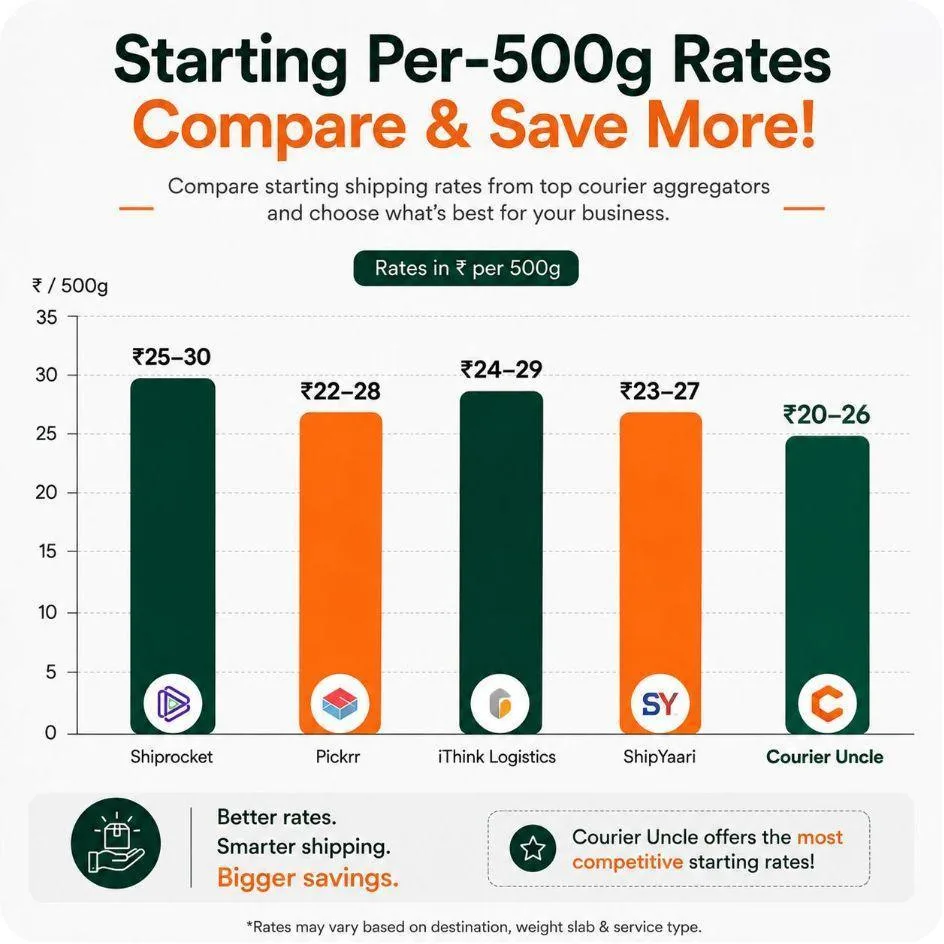
A courier rate looks like one number. It is actually five decisions stacked on top of each other, and every one of them is something you can influence. This is the full anatomy of an Indian domestic parcel rate, with the numbers, so the next quote you see reads like a formula instead of a price tag.
The five inputs every rate card uses
Every domestic courier in India, from Delhivery to Ekart to Shadowfax, prices a parcel from the same five inputs. The rate cards differ in the numbers, not the structure.
| Input | What it is | Who controls it |
|---|---|---|
| Chargeable weight | The higher of dead weight and volumetric weight | You (packaging and box size) |
| Zone | How far the parcel travels, in five bands | Your warehouse location and the buyer |
| Service | Surface or air, standard or express | You, at booking |
| Payment mode | Prepaid or cash on delivery | Your checkout |
| Add-ons | RTO, reattempt, special handling | Mostly your delivery success rate |
Get the first two right and you have understood eighty percent of your bill.
Input one: chargeable weight
Couriers charge for whichever is greater: what the parcel weighs, or how much space it takes up. The space figure is called volumetric weight and is computed as length x width x height in centimetres, divided by 5000.
A 30 x 25 x 15 cm box holding a 600 g kurta: dead weight 0.6 kg, volumetric weight 30 x 25 x 15 / 5000 = 2.25 kg. You are billed for 2.25 kg. Same kurta in a 28 x 20 x 4 cm poly mailer: volumetric 0.45 kg, billed at 0.6 kg. That one packaging change is the difference between a 0.5 kg slab and a 2.5 kg slab, which on most cards is more than double the price.
Input two: zone
Indian rate cards use five zones, and the price roughly doubles between the first and the last.
| Zone | Meaning | Typical index (Zone A = 100) |
|---|---|---|
| A | Within the same city | 100 |
| B | Within the same state, or a neighbouring metro pair | 120 to 135 |
| C | Metro to metro (Delhi, Mumbai, Bengaluru, Chennai, Kolkata, Hyderabad, Ahmedabad, Pune) | 140 to 160 |
| D | Rest of India | 165 to 190 |
| E | North East, Jammu and Kashmir, Himachal, Andaman, Lakshadweep | 200 to 260 |
The zone is decided by the pickup pincode and the delivery pincode. If sixty percent of your orders come from Maharashtra and you ship from Delhi, every one of them is Zone C or D. A second pickup point in Bhiwandi turns most of them into Zone A or B. That is a warehouse decision, not a courier decision, and it is the largest single lever on your average shipping cost.
Input three: the slab
Rate cards do not price per gram. They price in slabs. A typical card looks like this for Zone C:
| Slab | Charge |
|---|---|
| Up to 0.5 kg | Rs 48 |
| 0.5 to 1 kg | Rs 72 |
| 1 to 2 kg | Rs 110 |
| 2 to 3 kg | Rs 145 |
| Each additional kg | Rs 34 |
A parcel at 0.51 kg pays Rs 72, not Rs 48. The slab edge is a cliff, and a lot of packaging optimisation is about staying on the right side of it. If your product is 480 g, your packaging budget is 20 g. Choose the poly mailer, not the box.
Input four: surface or air
Surface is the road and rail network and is the default for almost everything under 5 kg. Air is faster by one to three days on Zone D and E lanes and costs 30 to 60 percent more on most cards. For Zone A and B it makes no difference at all, because the parcel is delivered before an air leg would have been scheduled. Pay for air only when the lane is long and the buyer is waiting.
Input five: prepaid or COD
Cash on delivery adds a collection fee. Every card defines it the same way: the higher of a flat amount and a percentage of the amount collected. A typical card says Rs 30 or 1.8 percent, whichever is higher.
- Rs 499 order: 1.8 percent is Rs 9, so you pay the flat Rs 30.
- Rs 2,499 order: 1.8 percent is Rs 45, so you pay Rs 45.
The COD fee is also where quotes and bills part ways. If you quote a rate without telling the calculator the COD amount, it will show you the flat fee. The booking knows the amount and charges the percentage. Always quote with the real COD value.
What is not in the rate
Three things sit outside the freight line and surprise sellers on the invoice.
GST. Courier services attract 18 percent GST on the freight and the COD fee. A quoted Rs 100 rate is Rs 118 on the invoice. If your business is GST registered, you claim it back as input credit, so the real cost is Rs 100. If you are not registered, the 18 percent is yours to absorb.
RTO. When a parcel cannot be delivered and comes back, most cards charge the forward freight again for the return leg. A Rs 90 Zone D shipment that returns costs Rs 180 plus GST, and you still have not sold anything.
Weight discrepancies. Couriers reweigh at the hub. If the parcel measures heavier than you declared, the difference between the two slabs is charged after the fact. This is the most common “hidden” charge and the most avoidable: declare the real weight and real dimensions.
A complete worked example
A Delhi seller ships a Rs 1,499 COD order to Pune. The product weighs 700 g and goes in a 32 x 24 x 10 cm box.
- Volumetric weight: 32 x 24 x 10 / 5000 = 1.54 kg. Dead weight 0.7 kg. Chargeable weight 1.54 kg, which lands in the 1 to 2 kg slab.
- Zone: Delhi to Pune is metro to metro, Zone C.
- Slab rate for Zone C, 1 to 2 kg: Rs 110.
- COD fee: higher of Rs 30 and 1.8 percent of Rs 1,499 (Rs 27), so Rs 30.
- Freight plus COD: Rs 140. GST at 18 percent: Rs 25.20. Invoice: Rs 165.20.
Now the same order in a 30 x 22 x 6 cm box: volumetric 0.79 kg, chargeable 0.79 kg, slab 0.5 to 1 kg at Rs 72. Invoice: (72 + 30) x 1.18 = Rs 120.36. Rs 45 saved on one order by changing nothing but the box.
How an aggregator changes the arithmetic
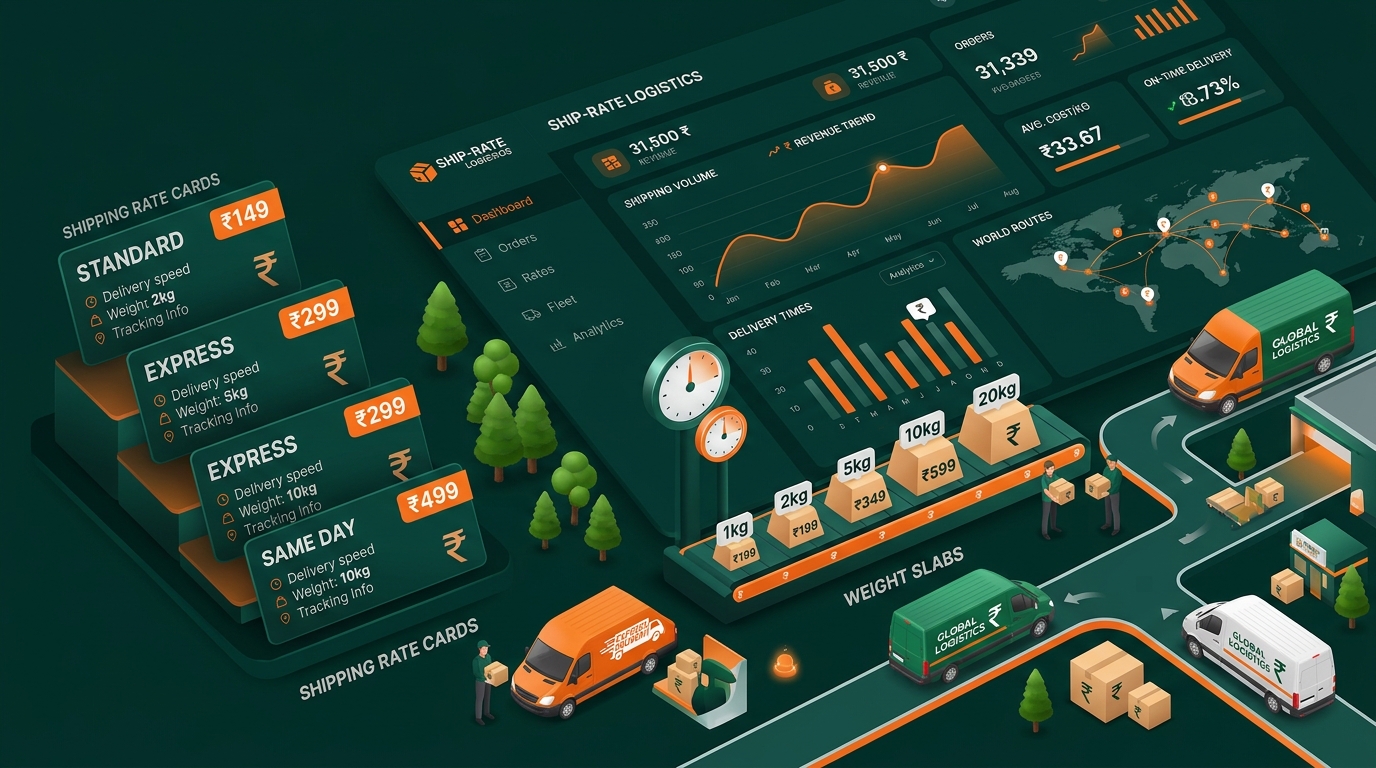
None of the five inputs change when you book through an aggregator. What changes is that you see all twelve couriers’ answers to the same five inputs side by side, on rates negotiated across thousands of sellers rather than your volume alone. On a given lane, the gap between the cheapest and the dearest courier for the same slab is routinely 25 to 40 percent. Picking the right one per order is worth more than any negotiation you could do on your own.
Frequently asked questions
Why is my Zone D rate almost double my Zone A rate?
Because the parcel travels through more hubs, more line-haul legs and a last-mile network the courier runs at lower density. The cost of moving a parcel from Delhi to a district town in Odisha is genuinely higher than moving it across Delhi, and the zone bands reflect that.
Is the rate the same for a 0.51 kg and a 0.99 kg parcel?
Yes. Both sit in the 0.5 to 1 kg slab and pay the same. Slabs are cliffs, not ramps, which is why keeping a parcel just under a slab edge matters.
Does every courier use the 5000 divisor for volumetric weight?
For domestic surface parcels, yes, almost universally. Some air and international services use 4000 or 6000, which makes bulky parcels dearer. Check the card for the specific service.
Are the rates on Courier Uncle inclusive of everything?
The quoted rate is the freight plus the COD fee where applicable. GST at 18 percent is added at booking and shown separately so you can claim it. RTO is charged only if the parcel returns, and weight discrepancies only if the hub reading is higher than what you declared.
Why does the quote differ from the amount debited?
Usually because the quote was made without the COD amount, or with dimensions different from what was booked. Quote with the same numbers you book with and the two match to the paisa.
Can I get a lower rate by committing to volume?
With a single courier, yes, but the thresholds start at several thousand parcels a month. On an aggregator the pooled volume is already there, which is why a new seller’s first parcel gets a rate a single courier would reserve for a large account.
Ship smarter with Courier Uncle
Compare all twelve couriers on the same parcel, with the real COD amount and real dimensions, and the number you see is the number you pay. Create a free account and quote your last ten orders; most sellers find one lane they have been overpaying on for months.
Ship smarter with Courier Uncle
Compare live rates across multiple couriers on your actual routes — sign-up is free, no volume commitment.
Compare rates free →