
Cutting Packaging Weight: Where the Grams Actually Are
9 September 2026 · 6 min read · by Courier Uncle team
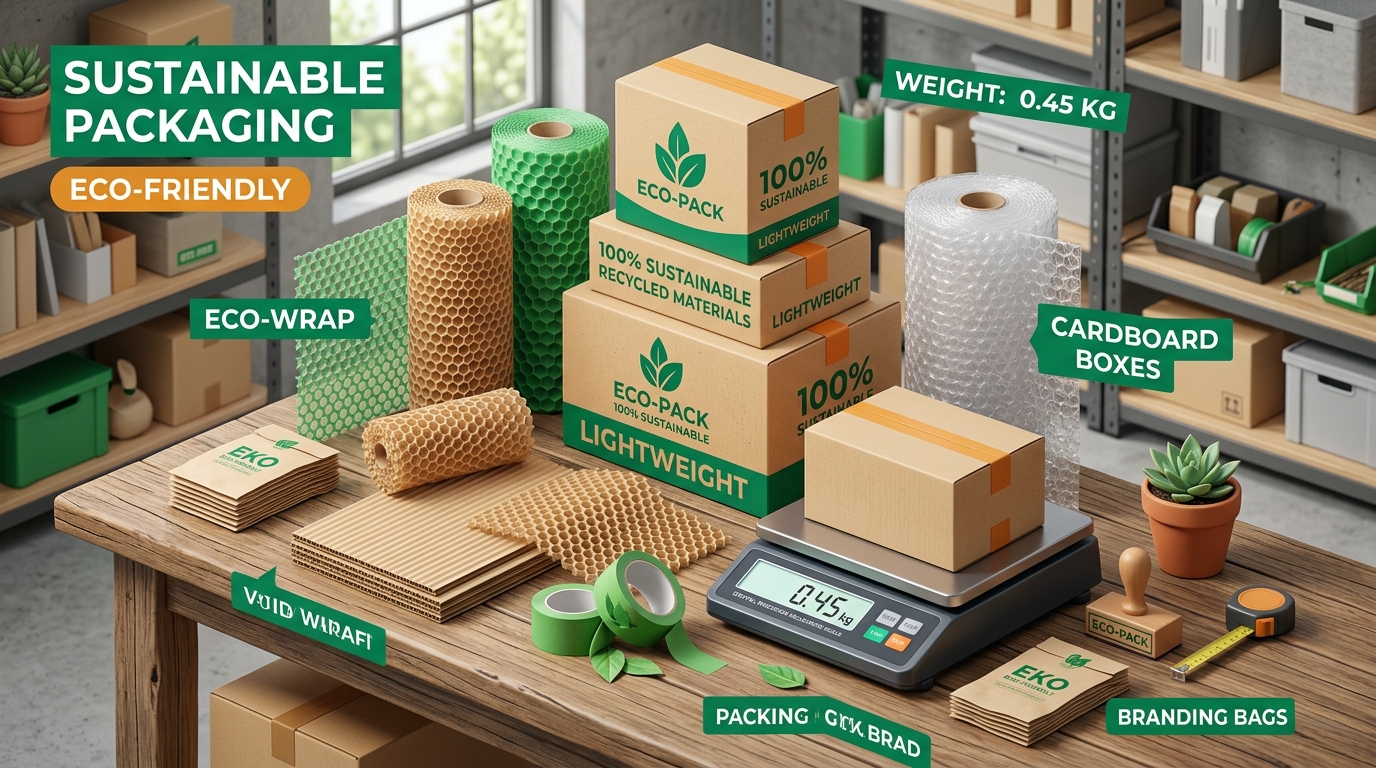
Packaging is the only part of your shipping cost that you control completely and can change this week. Not the courier’s rates, not the zones your buyers live in, not the fuel price. The box, the fill, the tape and the outer layer are yours, and on a typical e-commerce parcel they decide the slab more often than the product does.
Two numbers, two attacks
A parcel is billed on the higher of dead weight and volumetric weight. Packaging affects both, and which one you attack depends on which one is winning.
If the product is dense (cosmetics, books, hardware), dead weight wins and every gram of packaging counts. If the product is light and bulky (apparel, decor, toys), volumetric wins and every centimetre counts. Run your top ten SKUs through the rate calculator with their current packaging and note which figure is higher for each. That tells you where to start.
Attack one: grams
A typical corrugated shipping box weighs 120 to 250 g. A poly mailer weighs 8 to 15 g. Bubble wrap adds 20 to 60 g per parcel; crumpled paper 30 to 80 g; a printed insert 5 to 10 g; a second layer of tape 10 g.
For a 420 g product in a box with fill, the sealed parcel is typically 620 to 700 g, which is the 1 kg slab. The same product in a padded mailer is 450 to 470 g: the 0.5 kg slab. On a Zone C card that is Rs 26 per parcel.
Where to cut:
- Box to mailer wherever the product tolerates it. Soft goods, flat goods, anything already in a retail box that can take a label.
- Lighter board. Three-ply corrugated at 350 to 400 GSM instead of five-ply for parcels under 2 kg. The strength difference does not matter for a 500 g product.
- Fill only where there is movement. Fill exists to stop the product moving. If the box fits, there is no movement and no fill needed. Air pillows weigh a fraction of paper.
- One strip of tape across the seam, not an H pattern in three passes.
Attack two: centimetres
Volumetric weight is L x W x H / 5000. Height is the dimension most often padded, and the one where a reduction pays fastest.
| Box | Dimensions | Volumetric |
|---|---|---|
| Standard | 30 x 25 x 12 cm | 1.80 kg |
| Lower lid | 30 x 25 x 8 cm | 1.20 kg |
| Right-sized | 28 x 22 x 6 cm | 0.74 kg |
Three boxes, three slabs, one product.
Where to cut:
- More box sizes. Two sizes means most parcels are in a box too big for them. Six to eight sizes, chosen against your actual SKU dimensions, brings the average volumetric weight down by 30 to 50 percent in most catalogues.
- Measure the product and add 1 cm, not 5. The gap between product and box is where volumetric weight lives.
- Drop the outer box. If the product’s retail box is corrugated or rigid, ship in it. Double boxing is the single most common cause of a two-slab jump.
- Fold, roll, flatten. Apparel folded to the mailer’s footprint ships in 3 cm of height. Apparel on a hanger-shaped board ships in 10.
The audit, step by step
- List your top twenty SKUs by volume. They are most of your parcels.
- For each, record the bare product weight and dimensions, the packed parcel weight and dimensions, and the packaging used.
- Compute dead weight, volumetric weight and the slab for each, with the rate calculator.
- For each SKU where packaging pushed it up a slab, design the smallest safe pack: mailer, right-sized box, or retail box with a label.
- Test five parcels of each redesign through a real shipment. Check for damage claims and hub discrepancies.
- Roll out and re-measure after a month. The dashboard’s average chargeable weight should have moved.
Sellers who do this usually find that a third of their SKUs were shipping one slab too high and a tenth were shipping two slabs too high.
The trade-off with damage
Lighter packaging fails more often only if it is under-specified for the product. The rule is to protect against the actual risk, not every risk. A t-shirt does not need bubble wrap. A ceramic mug does, and a mug should never be in a mailer. Match the pack to the SKU rather than choosing one pack for everything, and damage rates stay flat while weight falls.
Keep a damage log by SKU and packaging. If a redesign shows a damage rate above 0.5 percent, step it back one level.
Where the money is
A seller doing 1,000 parcels a month, average Zone C, who moves a third of parcels down one slab and a tenth down two slabs, saves roughly Rs 26 x 333 + Rs 66 x 100 = Rs 15,258 a month. The box redesign costs a few thousand rupees once. Nothing else on the shipping bill has that return.

Frequently asked questions
Will a mailer protect my product?
For soft goods, flat goods, and products in their own retail box, yes. For anything fragile, liquid or with corners that can be crushed, use a right-sized box. The point is to match the pack to the risk.
How many box sizes should I stock?
Enough that most parcels have less than 2 cm of gap on each side. For most catalogues that is six to eight sizes. Fewer than four almost guarantees air in the box.
Does lighter packaging increase hub discrepancies?
No; discrepancies come from declaring numbers that do not match the parcel. Redesign the pack, re-measure, update the SKU’s declared weight and dimensions, and the numbers match.
What about branded packaging?
Print on the mailer or the right-sized box. A branded box that is 30 percent bigger than the product costs a slab on every order for the sake of the unboxing, which is a decision to make with the number in front of you.
Is it worth paying more for lighter board?
Usually. The difference in board cost is a rupee or two per box; the difference in slab is Rs 26 or more. Lighter board on parcels under 2 kg pays back on the first shipment.
How do I know the redesign worked?
Average chargeable weight on the dashboard, month over month, and cost per order. Both should fall. If discrepancies rise, the declared dimensions were not updated with the new pack.
Ship smarter with Courier Uncle
Run any SKU in two packs through the rate calculator and see the slab change before you buy boxes. Start free.
Ship smarter with Courier Uncle
Compare live rates across multiple couriers on your actual routes — sign-up is free, no volume commitment.
Compare rates free →