
Why Your Courier Bill Is Higher Than the Quote: Six Causes, Ranked
9 September 2026 · 6 min read · by Courier Uncle team
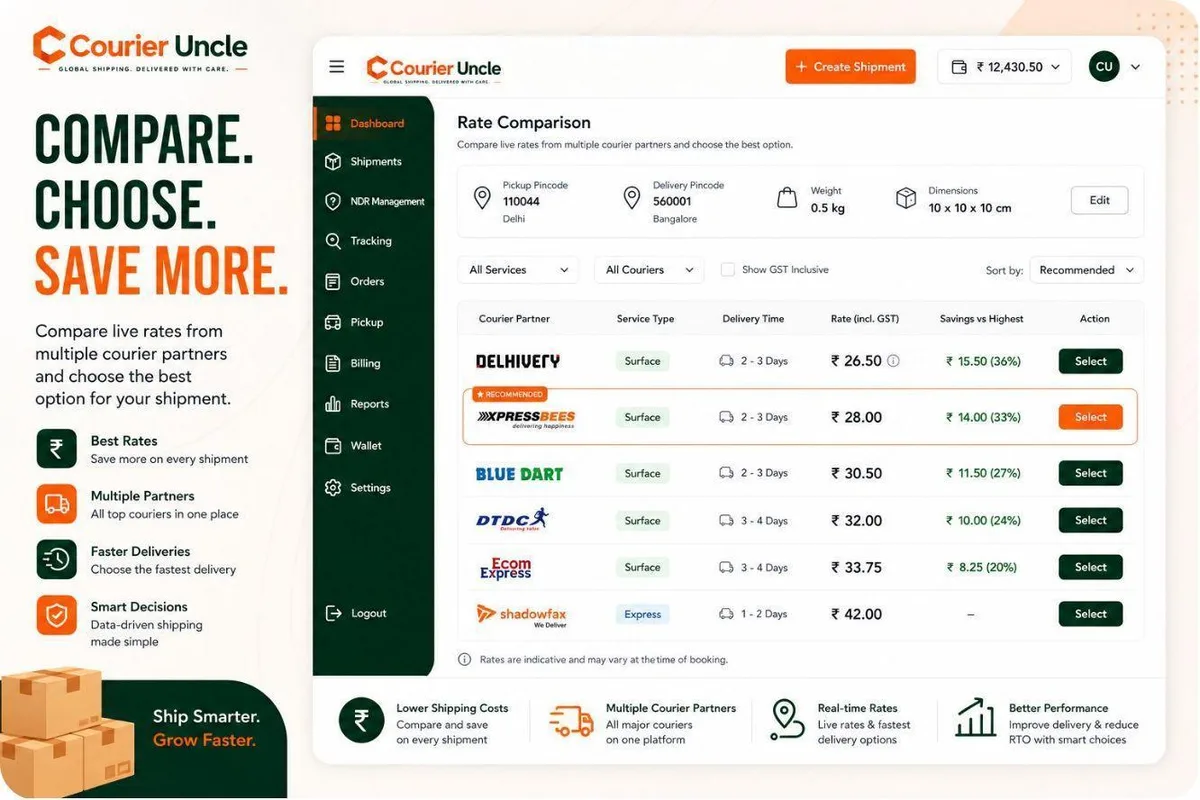
You quoted Rs 72, booked, and the wallet shows Rs 130 gone. Nobody enjoys that moment. The good news is that there are only six reasons a courier bill can exceed its quote, every one of them is diagnosable from the shipment record, and four of the six are preventable at booking time.
Reason one: GST
The most common and the most benign. Quotes are shown before tax; invoices include 18 percent GST on the freight and COD fee. Rs 72 becomes Rs 84.96. If you are GST registered you claim it back, so nothing is actually lost. If the gap between quote and bill is exactly 18 percent, this is your answer.
Reason two: the COD amount was not in the quote
The COD collection fee is the higher of a flat amount and a percentage of the order value. If you ran the quote without entering the COD amount, the calculator assumed the flat fee. At booking, the real amount is known and the percentage applies. On a Rs 2,999 order with a Rs 30 or 1.8 percent card, that is Rs 54 instead of Rs 30.
Fix: always quote with the real COD value. On Courier Uncle the rate request accepts the COD amount, and the quote then matches the booking exactly.
Reason three: the dimensions changed
You quoted with 25 x 20 x 5 cm and booked with 30 x 25 x 10 cm because the packer used a different box. Volumetric weight went from 0.5 kg to 1.5 kg and the slab jumped two steps. The bill is correct for the parcel that shipped; the quote was for a parcel that did not.
Fix: standardise boxes per SKU and put the box dimensions in the product record, so the person quoting and the person packing use the same numbers.
Reason four: the hub weighed it heavier
Every parcel is reweighed and measured at the courier’s hub. If the reading is higher than what you declared and pushes the parcel into a higher slab, the difference is charged after the fact as a weight discrepancy. This is the reason behind most “surprise” charges, and it is a separate line on the shipment, not a change to the freight.
Fix: declare the real dead weight and the real outer dimensions. If a discrepancy is raised and you know your numbers are right, dispute it within seven days with proof (a photo of the parcel on a scale, the packing video and the manifest, in a public Drive link). If the courier’s reading is right, accept it and fix the SKU’s declared weight so it does not recur.
Reason five: the parcel returned
An undelivered parcel that comes back is charged the forward freight again for the return leg on most cards. A Rs 72 shipment that RTOs is Rs 144 plus GST. The quote was for one journey; the parcel made two.
Fix: this is a delivery-success problem, not a pricing one. Confirm COD orders before shipping, use address validation at checkout, and act on NDR notifications the same day.
Reason six: the courier changed
If you quoted one courier and the platform booked another (because the first was not serviceable for that pincode, or your courier rules preferred another), the rate is that courier’s rate. On Courier Uncle the booking response names the courier and the charge, so this is visible immediately.
Fix: if you want a specific courier, pass its code at booking rather than leaving the choice to the rules.
Diagnosing a specific shipment
Open the shipment and check these in order. The first one that differs from the quote is the cause.
| Check | Where to look | If it differs |
|---|---|---|
| Tax | Invoice shows GST line | Reason one |
| COD fee | Shipment charge breakdown | Reason two |
| Declared dimensions and weight | Shipment record | Reason three |
| Discrepancy line | Weight disputes page | Reason four |
| Status RTO | Shipment timeline | Reason five |
| Courier name | Booking response or shipment header | Reason six |
What a matching quote and bill looks like
On Courier Uncle the quote engine and the booking engine are the same code path. Quote with the same weight, dimensions, payment mode, COD amount and pickup pincode that you book with, and the freight debited equals the freight quoted, to the paisa. A nightly audit compares the two on every live shipment and flags any mismatch to the team, so if a difference ever appears, it is one of the six reasons above and not a pricing error.
Frequently asked questions
Is a higher bill ever just a mistake?
Rarely, and it is detectable. Compare the six checks above. If none of them explains the gap, write to support with the tracking id; every charge is logged with its reason and can be reversed if it is wrong.
Why is the COD fee different on two orders with the same weight?
Because it depends on the order value, not the weight. Above the breakeven point (around Rs 1,600 on a Rs 30 or 1.8 percent card), the percentage exceeds the flat fee and the fee rises with the order value.
Can a weight discrepancy be charged weeks later?
It can be raised whenever the courier’s hub data reaches the platform, which is usually within a few days of pickup. You then have seven days to accept or dispute it before it is charged automatically.
Does the platform charge anything on top of the courier?
No. The quote is the courier’s rate on your card. There is no booking fee, no platform fee and no subscription. GST is the only addition and it is the government’s.
What happens if my wallet cannot cover a discrepancy charge?
The charge is applied and the wallet goes negative. Bookings pause until it is topped up back above the floor. It is better to keep a small buffer than to have a live order blocked.
How do I get the quote to include the COD fee correctly?
Enter the COD amount in the rate calculator, or pass it in the rates API call. The fee is then computed on the real amount.
Ship smarter with Courier Uncle
Quote and book from the same engine, and the numbers match. Try it on your next order, free to sign up.
Ship smarter with Courier Uncle
Compare live rates across multiple couriers on your actual routes — sign-up is free, no volume commitment.
Compare rates free →