
Cheapest Way to Ship Heavy Boxes Within India: A Decision Guide for Sellers
5 November 2026 · 14 min read · by Courier Uncle team
Cheapest Way to Ship Heavy Boxes
Within India: A Decision Guide for Sellers
Two sellers ship a 25 kg box from the same city to the same city. One pays far more than the other. Same weight, same route, very different bills. Why?
When you ship heavy boxes, the price depends on how the courier or transport company counts weight, what service you pick, and what extra charges get added. Most sellers only compare the headline rate, and that is where the money leaks.
This guide is about finding the cheapest way to ship heavy boxes within India. It is for D2C sellers, shopkeepers and wholesalers in Mumbai, Bangalore, Delhi NCR, Noida, Chennai and beyond. The cheapest option is not the lowest quote. It is the lowest cost per kg that actually reaches your customer.
The Quick Answer: What Makes a Heavy Shipment Cheap?
There is no single cheapest way. It depends on the weight, the size, the route and how many boxes you send.
Three things decide your cost:
Billable weight: the weight the courier actually charges you for
Route: how far the box travels, and to which zone
Service type: parcel courier, cargo service, PTL or full truck
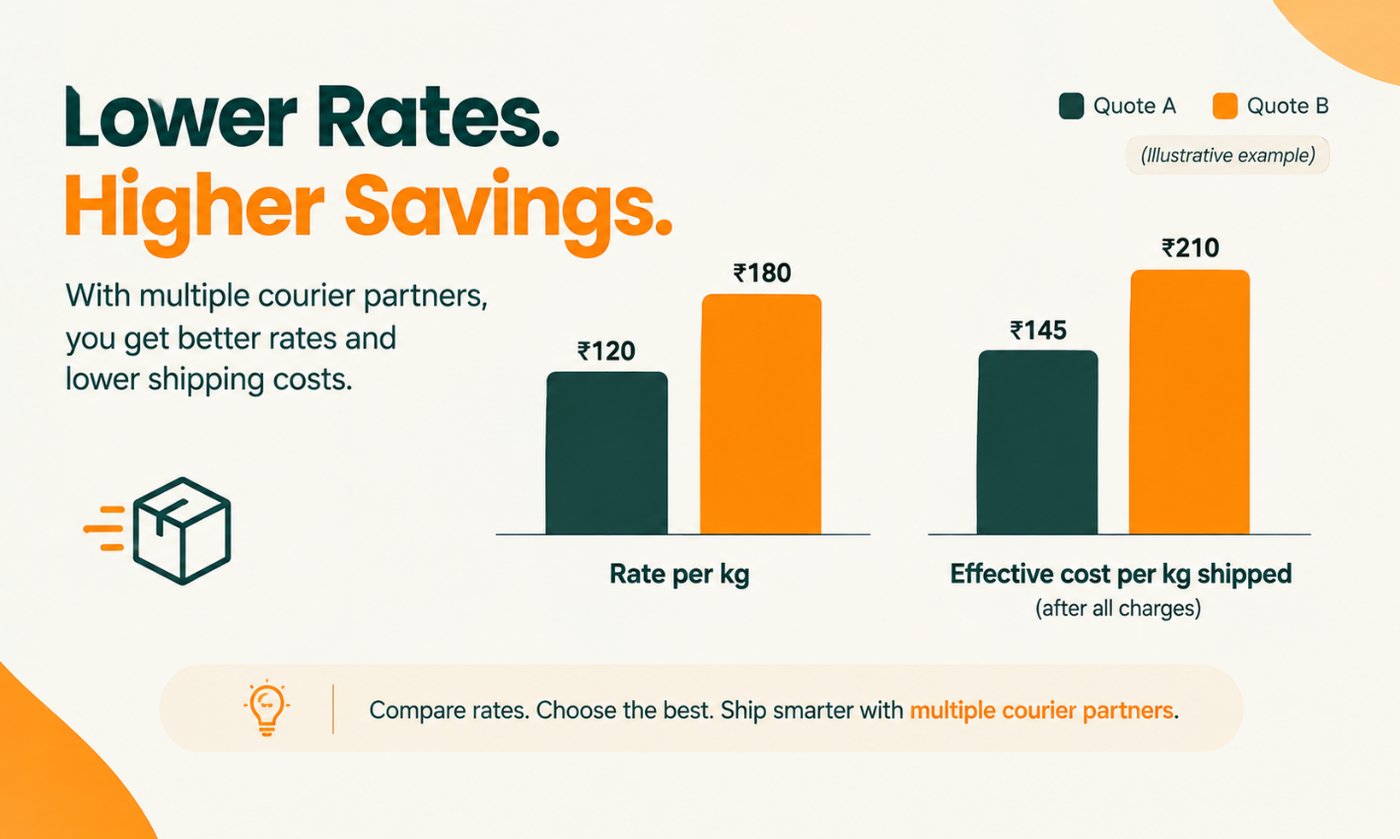
Before you compare anything, work out whether your problem is a heavy box or a bulky box. They are not the same.
Many guides treat “heavy” and “bulky” as one thing. They are not, and the fix is different for each.
| Type of box | What drives the bill | Where savings come from | Example |
|---|---|---|---|
| Heavy and dense | Actual weight | A lower per-kg rate, a better service type | A box of tools or books |
| Light but bulky | Volumetric weight (box size) | A smaller, right-sized box | A large box of cushions |
| Heavy and bulky | Whichever is higher, plus extra handling | Both: right-size the box and compare service types | Gym equipment, small appliances |
Here is a simple test. Weigh the box. Then work out its volumetric weight with this formula, using the box size in centimetres:
Volumetric weight (kg) = length x breadth x height / 5000
The courier usually charges the higher of the two. Some couriers use a different divisor, so confirm it with yours.
We’ve broken down volumetric weight and packaging fixes in more detail here.
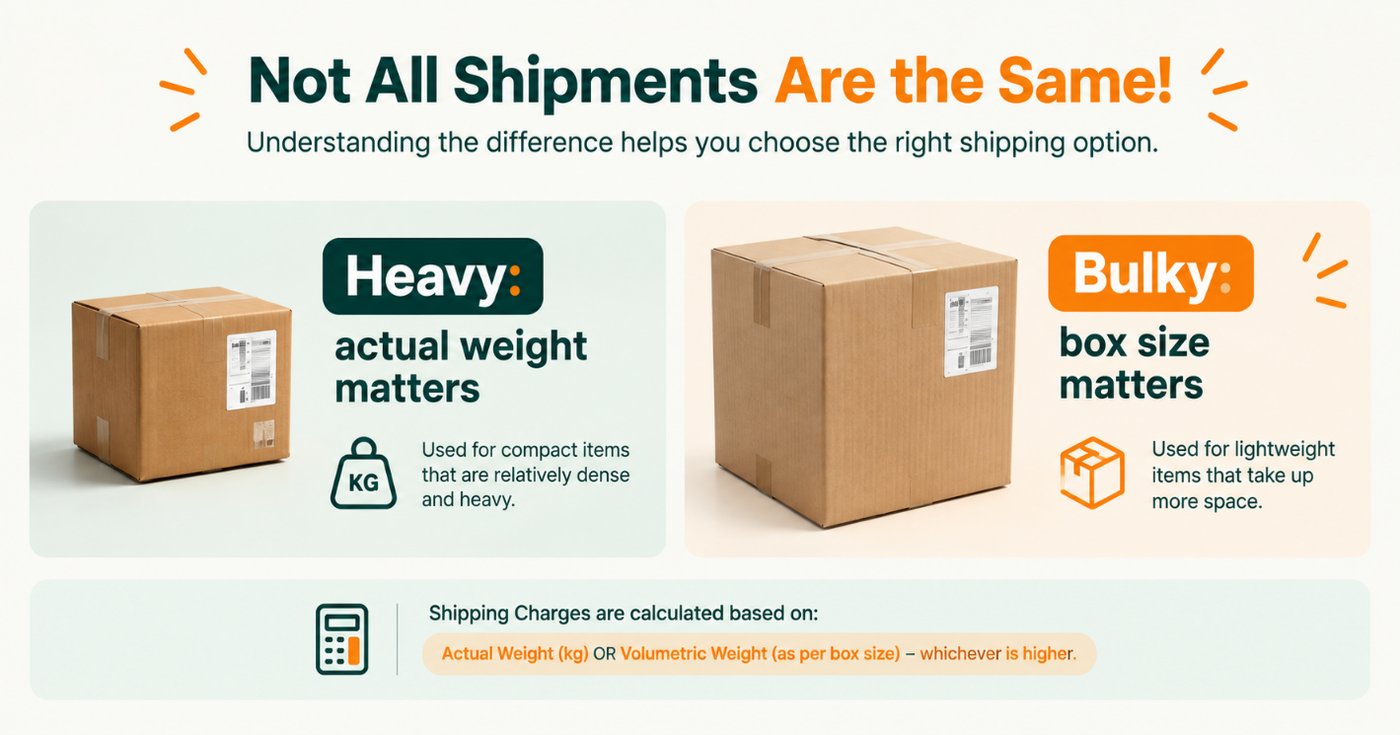
The Shipping Ladder: Parcel, Cargo, PTL and Full Truck
Heavy shipments do not have to go through a normal parcel booking. As the load grows, you can climb a ladder of options, each built for a different size of shipment.
| Step | What it is | Often good for | Watch out for |
|---|---|---|---|
| 1. Parcel courier | Standard courier booking, priced per weight slab | One or a few boxes of moderate weight | Courier weight limits, heavy-item surcharges |
| 2. Heavy or surface cargo service | A slower service built for heavier, bulkier loads | Several boxes or heavier loads where time is flexible | Minimum billable weight, longer delivery time |
| 3. PTL or LTL (part truck load) | Your goods share a truck with other shippers’ goods, usually booked with a transport company | Large multi-box or palletised loads | Pickup and delivery arrangements, handling at transfer points |
| 4. Full truck load | You book a whole truck for your goods | Very large loads | Only worth it when the load is big enough to fill most of the truck |
A note on switching: there is no single weight at which you should move from one step to the next. It changes with the courier, the route and the load. So do not guess. Take quotes for the same shipment from two or three steps on the ladder and compare the effective cost per kg, which the next section explains.
One more thing that confuses many sellers: a courier company and a transport company are not the same. Courier companies run parcel networks. Transport companies (often called lorry offices) usually handle heavier loads and bookings for part or full trucks.
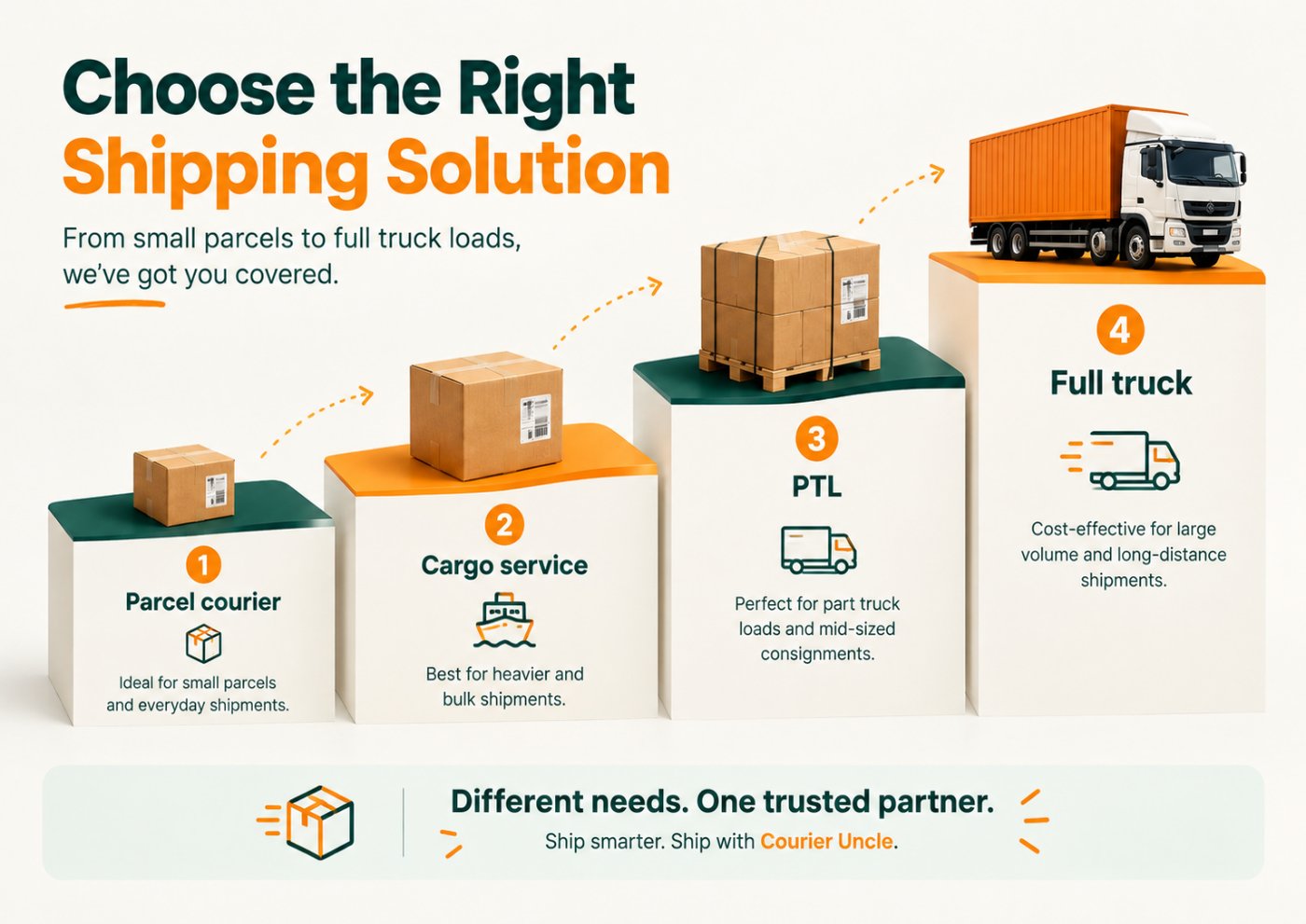
Calculate Your Effective Per-Kg Cost
A low rate per kg can still end up costing more. Minimum billable weight, pickup charges and surcharges all change the final bill. Use this instead:
Effective cost per kg = total landed cost / weight you actually ship
Total landed cost means everything you pay: freight, pickup, surcharges, insurance and taxes. Divide by the weight you actually ship, not the billable weight. If you divide by billable weight, a minimum weight rule can hide its own cost.
Here is an illustrative example. You are shipping 30 kg. Quote B has a lower rate per kg, but it charges for a minimum of 50 kg.
| Same 30 kg shipment | Quote A | Quote B |
|---|---|---|
| Rate per kg | ₹45 | ₹30 |
| Minimum billable weight | None | 50 kg |
| Freight (rate x billable weight) | ₹1,350 (30 kg) | ₹1,500 (50 kg) |
| Pickup charge | ₹0 | ₹200 |
| Surcharges | ₹150 | ₹0 |
| Insurance | ₹100 | ₹100 |
| Taxes (illustrative 18%) | ₹288 | ₹324 |
| Total landed cost | ₹1,888 | ₹2,124 |
| Effective cost per kg shipped (total / 30 kg) | about 63₹ | about 71₹ |
These numbers are illustrative. The tax rate is an assumption for the example, and real rates and rules will differ.
Quote B looks cheaper at 30 per kg against 45. But after the minimum weight and the pickup charge, Quote A costs ₹ ₹ less for the same 30 kg. Now try it with your own quotes:
| Your numbers | Quote 1 | Quote 2 |
|---|---|---|
| Weight you actually ship (kg) | ||
| Freight (including minimum billable weight) | ||
| Pickup + surcharges + insurance | ||
| Taxes | ||
| Total landed cost | ||
| Effective cost per kg shipped |
We’ve covered these hidden courier charges in detail here, including fuel surcharge and weight rules.
Split Into Smaller Boxes or Ship One Big Box?
There is no universal answer. The right choice depends on your product, your route and the services you can use.
| Factor | Several smaller boxes | One big box |
|---|---|---|
| Handling | Easier to lift and move | Needs more effort, sometimes two people |
| Damage risk | A single damaged box affects only part of the order | A single failure affects the whole order |
| Per-parcel charges | May add up with more boxes | Fewer charges, but may trigger a heavy-item surcharge |
| Service options | Usually fits standard parcel services | May need a cargo or heavy service |
| Delivery | Easier for the buyer to receive | May need help with unloading or a lift |
A simple way to decide: get a quote for both options, compare the total landed cost, and then think about damage risk and how easy it will be for the buyer to receive the goods. If the two costs are close, the easier-to-handle option is usually safer.
How to Compare Heavy Shipping Quotes (Copy-Paste Table)
Quotes from different companies are rarely in the same format, which makes them hard to compare. Make them comparable first:
Use the same weight, the same box dimensions, the same pickup pincode and the same delivery pincode for every quote.
Ask for at least three quotes: a parcel courier, a cargo service and, for larger loads, a transport company.
Ask what is included: pickup, surcharges, insurance and taxes.
Ask for minimum billable weight and expected delivery time.
Get the quote in writing, by message or email. Then fill in this table:
| Option | Freight | Pickup | Surcharges | Insurance | Taxes | Total landed cost | Effective per kg | Delivery time |
|---|---|---|---|---|---|---|---|---|
| Parcel courier | ||||||||
| Cargo service | ||||||||
| PTL / transport company |
Before you send a large order, send one real shipment first. A single test parcel shows you the real pickup experience, delivery time and any extra charges.
Heavy Parcels and RTO: The Costly Combination
When a heavy parcel comes back as RTO, you pay for the way back too, and return freight is also charged by weight. A returned 30 kg box hurts a lot more than a returned 500 g parcel.
A few habits help:
Confirm the address, floor and a working phone number before you dispatch
If the order is COD, confirm it with the buyer first, or take a small advance
Tell the buyer when the box will arrive, so someone is there to receive it
We’ve covered RTO costs in more depth here. The full COD vs prepaid decision is covered here too.
Documents to Keep Ready for Heavy Shipments
Heavy and high-value shipments often need more paperwork than a small parcel. Here is a checklist.
| Document | Why you need it | Note |
|---|---|---|
| GST invoice | Proof of sale and a standard shipping document for a business seller | Keep a copy with the shipment and on record |
| E-way bill | May be needed for goods above certain values, depending on the rules | Rules and limits change. Confirm with your CA or the courier |
| Consignment note or docket | The transport company’s receipt for your goods, used for tracking and claims | Check the details before you sign |
| Insurance or risk terms | Decides who pays if goods are lost or damaged | Ask whether you are shipping at owner’s risk or carrier’s risk |
| Packing list and contact numbers | Helps the receiver check the goods and helps the driver reach them | Add a phone number that will be answered |
Rules and value limits for these documents change, so please confirm the current requirements with your CA or your courier or transport company.
Delivery Day Practicalities
Heavy boxes create problems at the doorstep that small parcels do not. A failed delivery attempt costs you money and time.
Ask the buyer these questions before you dispatch:
Which floor is the delivery address on, and is there a working lift?
Who will be there to receive and unload the box?
Is there a time of day that works best for delivery?
Is there a phone number that will be answered?
Some services offer a delivery appointment. If yours does, use it for heavy boxes.
Packing a Heavy Box So It Arrives Intact
Use a strong, double-walled carton that fits the goods, not a box that is far too big
Put the heaviest items in the middle and softer items around them
Protect corners and edges, and use good packing tape on all seams
Do not reuse an old or weak carton for heavy goods
Put the shipping label on the largest flat face, where it is easy to scan
A box that arrives intact saves you a damage claim, a replacement and a possible return.
Ways to Cut the Cost of Shipping Heavy Boxes
Work out your billable weight first: actual weight versus volumetric weight.
Right-size your packaging so you are not paying for empty space.
Compare at least three quotes instead of relying on one.
Batch your pickups, so you book once instead of several times.
Use a slower surface service when you do not need speed.
Always ask about minimum billable weight and surcharges along with the rate.
If you ship heavy boxes regularly, ask for a rate card based on your volume.
Batching pickups is covered in our Mumbai guide as well, if you want to see it in action.
A Real Example: The Seller Who Compared Three Quotes Instead of One
This is an illustrative example, based on a common pattern.
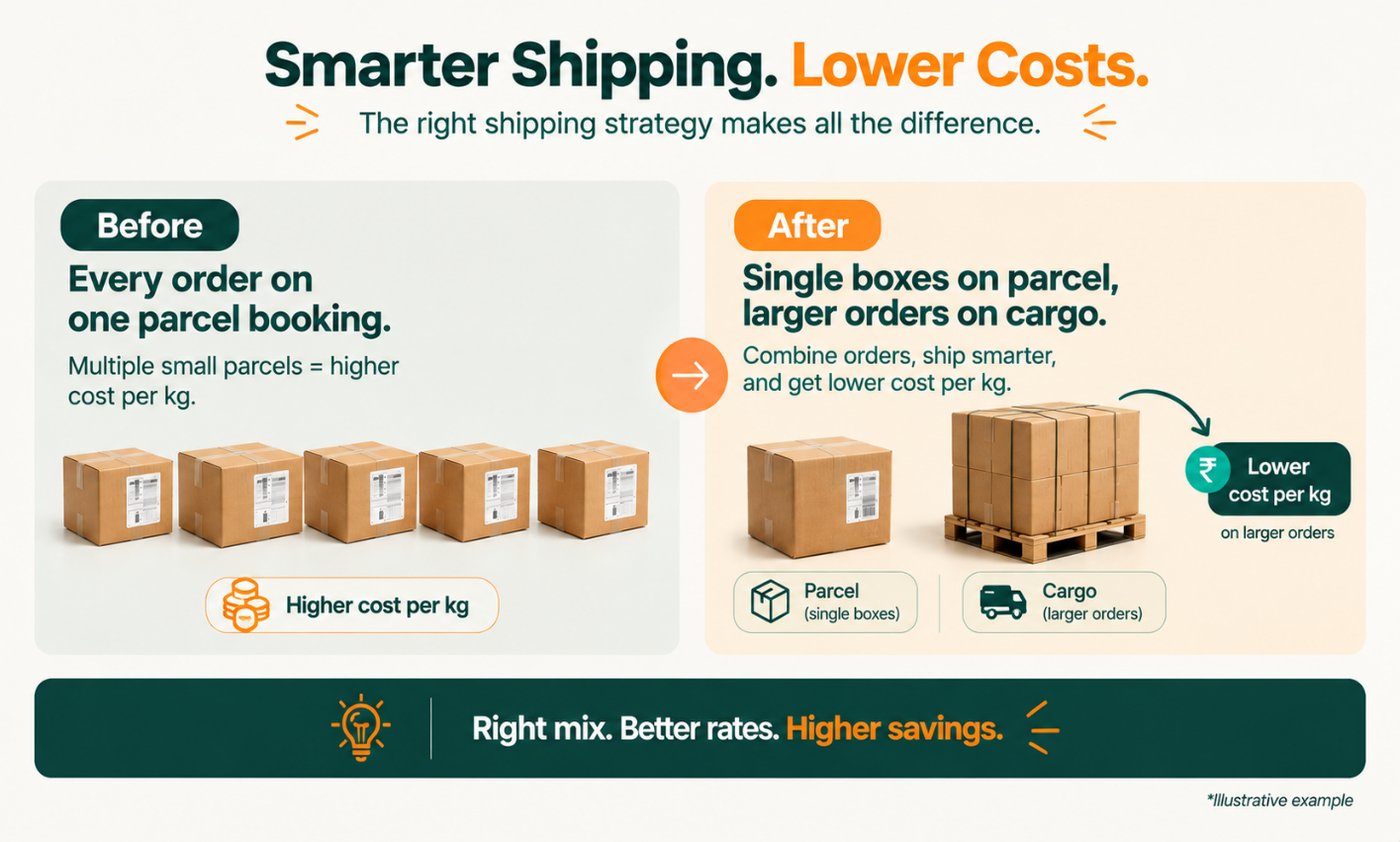
A seller in Noida sold gym accessories, and a typical order weighed 30 to 40 kg. For every order, he booked the same courier with a parcel rate, because that was the first one he had used.
One day he took three quotes for a 35 kg order: a parcel courier, a cargo service and a transport company. He wrote down the freight, pickup, surcharges and taxes, and divided each total by the weight he was shipping.
The parcel courier was still the best choice for single-box orders. But for larger orders with several boxes, the cargo service came out cheaper per kg. He kept single boxes on the parcel courier and moved the larger orders to cargo. On those bigger orders, his effective cost per kg came down by roughly a fifth.
He did not change his product or his customers. He just stopped assuming that one booking method was the cheapest for every order.
Where a Courier Aggregator Helps (and Where It Doesn’t)
For parcel-level heavy shipments, comparing several courier companies in one place can save you time and money. That is what an aggregator is for.
For PTL or full truck loads, you will usually need to ask transport companies directly for a quote, since those are booked differently from parcels.
Courier Uncle gives you access to 17+ courier partners, including Blue Dart, Delhivery and Shadowfax, in one dashboard, with same-day pickup, no hidden fees and no minimum commitment. For heavy parcels, check each courier partner’s weight limit and rules for your box before you book.
We’ve covered this decision in full depth here, including a real before-and-after example.
Frequently Asked Questions
What is the cheapest way to send a heavy parcel in India?
It depends on the weight, size, route and number of boxes. Compare the effective cost per kg from at least three options: a parcel courier, a cargo service and, for large loads, a transport company.
Up to how many kg can I send by courier?
Every courier has its own weight limit and its own rules for heavy items, so there is no single answer. Check the limits for your route before you book, and ask about heavy-item surcharges.
What is the difference between a courier company and a transport company?
A courier company runs a parcel network with tracking and doorstep delivery. A transport company, often called a lorry office, usually handles heavier loads and bookings for part or full trucks.
What is PTL and when should I use it?
PTL means part truck load. Your goods share a truck with other shippers’ goods. It is usually considered for larger loads that are too big for a normal parcel booking but do not need a full truck. Compare quotes to see if it is cheaper for your load.
How is the rate for a heavy parcel calculated?
It usually depends on the billable weight (the higher of actual and volumetric weight), the route or zone, the service type, and any extra charges such as pickup, surcharges and taxes.
Is it cheaper to ship one big box or several smaller boxes?
It depends. Several smaller boxes are easier to handle but may add per-parcel charges. One big box may trigger a heavyitem surcharge. Get a quote for both and compare the total cost.
Can I take COD on a heavy parcel?
You can, but the risk is higher, because a returned heavy parcel costs a lot to bring back. Confirm the order with the buyer first, or take a small advance.
Do I need an e-way bill for a heavy shipment?
It can depend on the value of the goods and the current rules. Confirm with your CA or your courier or transport company, since the rules change.
The Bottom Line
The cheapest way to ship heavy boxes is not one service or one company. It is a small calculation: work out your billable weight, compare quotes on the same shipment, and divide the total by the weight you actually ship.
Do that once for your usual order, and you will know where your money is going.
Want to compare courier rates for your parcel shipments in one place? Check Courier Uncle — free sign-up, no minimum commitment.
Note: All rates, weights and the case study in this article are illustrative. Courier and transport rules, weight limits, surcharges and tax or document requirements change, so please verify current details before you book.
Ship smarter with Courier Uncle
Compare live rates across multiple couriers on your actual routes — sign-up is free, no volume commitment.
Compare rates free →